Camping Chair Weight Capacity: What '300 lb Tested' Actually Means
"Holds 300 lb" vs "tested to 300 lb"
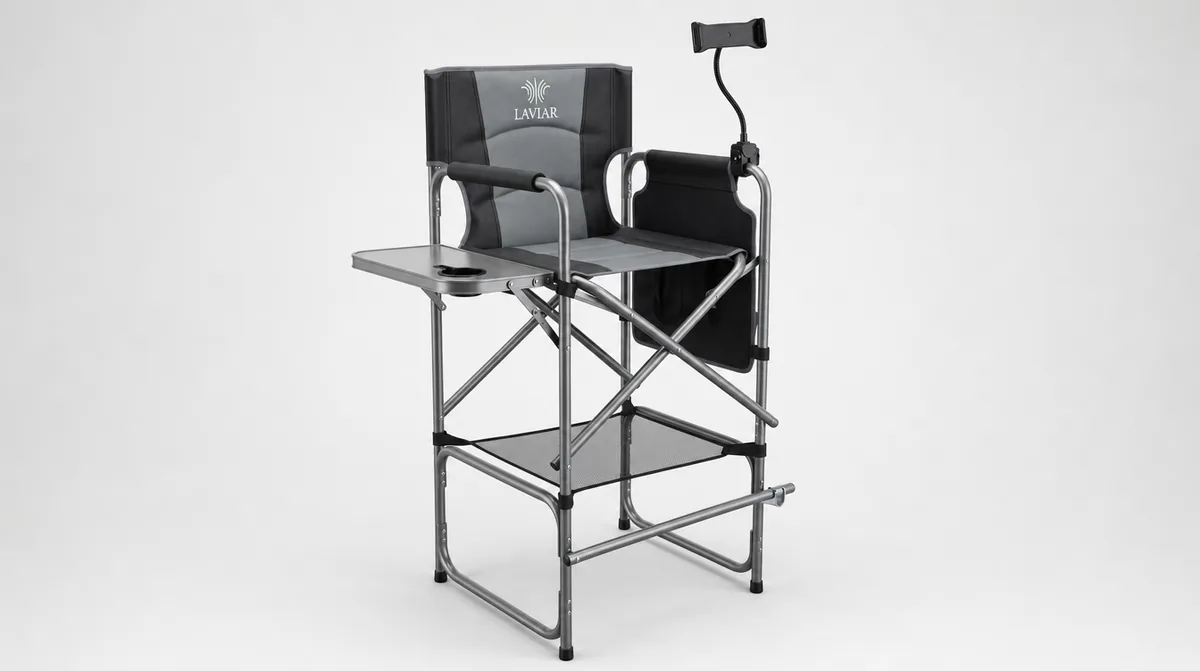
There is no U.S. law forcing outdoor chairs through a standard load test, so plenty of listings print a capacity nobody ever verified. The honest signal is the word tested backed by a report. The LAVIAR directors chair carries a 300 lb tested capacity with the load-test report on file. That is also a useful number to compare against reality: the average U.S. adult man weighs about 200 lb per CDC data, so a tested 300 lb rating leaves real margin, including the lean-and-shift loads of getting in and out.
Once you know to look for the wording, the pattern in the category becomes obvious. Numbers climb without anything else on the spec sheet changing. The same frame drawing appears under a 250 lb claim on one listing and a 400 lb claim on another. A rating that goes up while the tube diameter, the bracing, and the fabric all stay the same is a marketing number, and it is worth treating as decoration.
Static load is only half the question
A number on its own describes a person sitting still, which is not how anyone uses a chair. The load that actually breaks things is dynamic. Dropping into the seat instead of lowering into it multiplies the instantaneous force well past your body weight. Leaning back so the rear legs take everything concentrates that force on two contact points. Pushing off one armrest to stand puts your whole weight through a joint designed for a fraction of it. Someone sitting on the armrest while talking to you does the same thing sideways.
Good frames are designed around those moments rather than around the sitting-still case, which is why a chair that survives a static test can still fail in a season if the joints are plastic. The wording to look for is a tested static rating plus a frame description that names its materials, because together they tell you somebody thought about both.
What actually carries the load
Frame geometry does most of the work: a cross-braced X under the seat spreads load into four legs, and tall chairs add a lower stretcher bar that doubles as a footrest. Materials matter next, steel where stiffness counts, aluminum where weight counts, since all-plastic joints are the usual failure point. And the fabric should be double-layer 600D Oxford, which resists the seam tearing that kills cheap chairs.
Height changes the engineering, which is why a tall chair is not a normal chair on longer legs. Longer legs mean more leverage on every joint, so the bracing has to be stiffer to keep the frame from racking side to side. That lower stretcher bar earns its place twice, once as a footrest and once as the piece that stops the front legs from spreading. If you are comparing a tall chair against a low one on more than the rating, the director's chair against quad camp chair comparison covers how the two structures behave differently under the same person.
Denier, and why 600D keeps coming up
Denier measures the weight of the yarn, so a higher number means thicker threads and a heavier, more abrasion-resistant cloth. Budget camp chairs commonly use 300D or lighter polyester, which is fine for a season of light use and starts fuzzing at the contact points after that. 600D Oxford is the spec that shows up in gear built to sit outside repeatedly, and doubling the layer matters more than the number, because the failure happens at the stitch line rather than in the middle of the panel.
That is the part worth internalizing. Fabric almost never rips across the seat. It pulls apart where thread passes through it, at the corners and the frame pockets, because every stitch hole is a small weakness and load concentrates there. A second layer spreads that load across more material and moves the weak point back onto the frame, where it belongs.

Reading a spec sheet in 20 seconds
Look for four things. Does the capacity say tested, not just rated? Does the frame list steel and aluminum by name, not just "metal"? Is a fabric denier stated, 600D or higher? And does the chair weigh around 16 lb, heavy enough to be real, light enough to carry?
That last one surprises people. Weight is a proxy for material, and a chair claiming 400 lb at 6 lb total is claiming physics that the tubing cannot deliver. Somewhere near 16 lb for a full-size tall chair with a table and hardware is what an honestly built one weighs. Much lighter with the same claims means thinner walls, and much heavier usually means steel where aluminum would have done.
Ground conditions change the effective rating
Every capacity figure assumes a flat, firm surface. On soft sand, loose dirt, or wet grass the feet sink unevenly, the frame racks, and the load stops being spread across four legs. Nothing about that is unique to one brand, it is what happens to any metal-framed chair. The fix is a scrap of plywood or a set of wide furniture pads under the legs, which is worth packing before a beach site rather than discovering afterward. A slope does the same thing in a different direction, so face the chair across the slope rather than down it.
What a chair does when it is about to fail
Frames rarely snap without warning. They loosen first, and the warning signs are specific enough to act on. A side-to-side rock when you shift your weight means the cross bracing has developed play, usually at a rivet or a bolt. A creak that appears at one point in the motion of sitting down, rather than a general noise, means one joint is taking load the others are not. Feet that no longer sit flat on a level surface mean a leg has bent slightly, which changes how load is shared. And any fabric fraying visible at a frame pocket is the seam starting to go, which is the failure that drops people.
Most of that is fixable in ten minutes. Tighten every bolt once a season, check the frame pockets when you clean the fabric, and stop using the chair if a seam is opening rather than deciding it has one more weekend in it. A frame that gets checked outlasts a heavier one that does not, which is a bigger factor in real lifespan than the difference between a 300 lb rating and a 350 lb one.
What a 300 lb rating does not mean
It is not a step stool. Standing on the seat puts your entire weight through a few square inches of fabric at an angle nothing was designed for. It is not a two-person seat, and a child on a parent's lap is fine while two adults sharing is not. It is not a rating for the side table, which is built for a drink and a plate rather than for someone perching on it. And it is not a promise about the fabric over ten years of UV, which is a separate question that no capacity figure answers.
Where this sits in the buying decision
Capacity is the specification that predicts whether the chair is still usable in year three, which makes it the backbone of everything else. The height argument for a tall seat is covered in the piece on why seat height matters, the feature side is in the side table buying notes, and the category overview is in the guide to folding directors chairs for outdoor use. LAVIAR's chair is tested to 300 lb on a reinforced steel-and-aluminum frame with double-layer 600D Oxford, folds to about 16 lb with its carry bag, and lists at $99.99.
Frequently asked questions
Is a 300 lb camping chair rating enough?
For most adults, yes with margin: the average U.S. man weighs about 200 lb. The key is that the rating is tested, not just a claim on the box.
Why do camping chairs break at the seams?
Single-layer fabric tears at stitch lines under repeated load. Double-layer 600D Oxford, as used on the LAVIAR, moves the weak point back to the (stronger) frame.
What does 600D mean on a camping chair?
Denier is the yarn weight, so 600D is a thicker, more abrasion-resistant cloth than the 300D used on budget chairs. Double-layer 600D Oxford is the spec built for repeated outdoor use.
Can two people sit in one camping chair?
No. A 300 lb tested rating describes one person on a flat surface. Two adults load the frame in ways no seating test covers.