Folding Directors Chairs for Outdoor Use: Complete 2026 Guide
Directors chair vs bag-style camp chair
Bag chairs collapse into a cylinder, sit low, and flex under you. Directors chairs fold flat like a book: rigid frame, flat armrests, a stable rectangular footprint you can actually work from instead of just slump in. The trade-off is a flat fold instead of a tube fold, at a similar carry weight of about 16 lb with the bag.
The structural difference is worth understanding because it drives everything else. A bag chair hangs a fabric sling from four legs that pivot from a single central hub, so your weight pulls the legs inward and the fabric downward at the same time. That is why it feels like it closes around you. A director's chair stretches a seat panel between two rigid side frames braced under the seat, so your weight pushes down into four legs instead of pulling them together. The seat stays flat and stays where the spec sheet says it is.
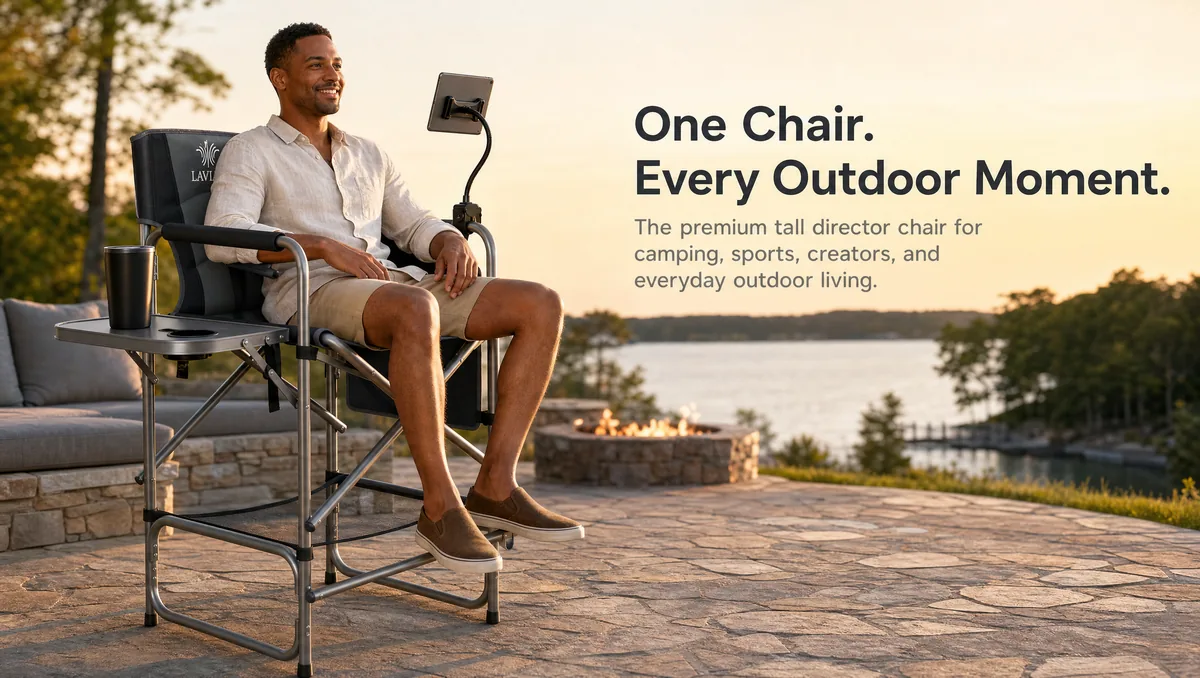
Standard vs tall
Standard directors chairs seat around 18 inches. Tall directors chairs seat around 30 inches with a footrest bar. Pick tall for sidelines, makeup work, trade shows, and anyone who hates climbing out of a low seat. Pick standard only if you need the lowest possible profile.
The full case for the tall version, including the height comparisons against dining chairs and bar stools, is in the article on tall camping chairs for adults. The short version: 30.7 inches sits above counter-stool height, which turns getting up into a forward step rather than a push off your knees, and it puts your eyes above a row of seated people. If you sit behind other spectators regularly, standard height gives you a view of the back of someone's head.
The fold, and what it costs you
Flat-fold and tube-fold are different storage problems, and neither wins in the abstract. A flat-folded chair is a thin rectangle roughly the width of the seat. It slides behind a car seat, under a kit case, into an RV basement bay, or against a garage wall, and two of them stack into barely more space than one. A tube-folded bag chair is a cylinder that stands upright in a trunk corner and takes almost no floor area but does not stack or lie flat under anything.
If your storage is a car trunk shared with a stroller, the tube wins. If it is an RV bay, a van, a booth load-out, or a garage wall, the flat fold wins. That is genuinely the whole decision on this point.
What "outdoor" has to mean on the spec sheet
A director's chair built for a film set and one built for a campsite look similar and are not. Outdoor use means the fabric has to take UV, rain, and abrasion, which is where 600D Oxford comes in, ideally double-layer. It means the hardware has to resist corrosion, which is where aluminum and coated steel matter rather than bare mild steel that will bloom rust after one wet weekend. And it means the frame has to survive being set up on ground that is not flat.
The capacity claim is the other half of it, and the wording is the tell. A frame described as tested to 300 lb is a different statement from one rated at 300 lb, and the difference is explained properly in the piece on what a tested weight capacity actually means. LAVIAR's chair is tested to 300 lb on a reinforced steel-and-aluminum frame with double-layer 600D Oxford.
The 2026 feature set worth paying for
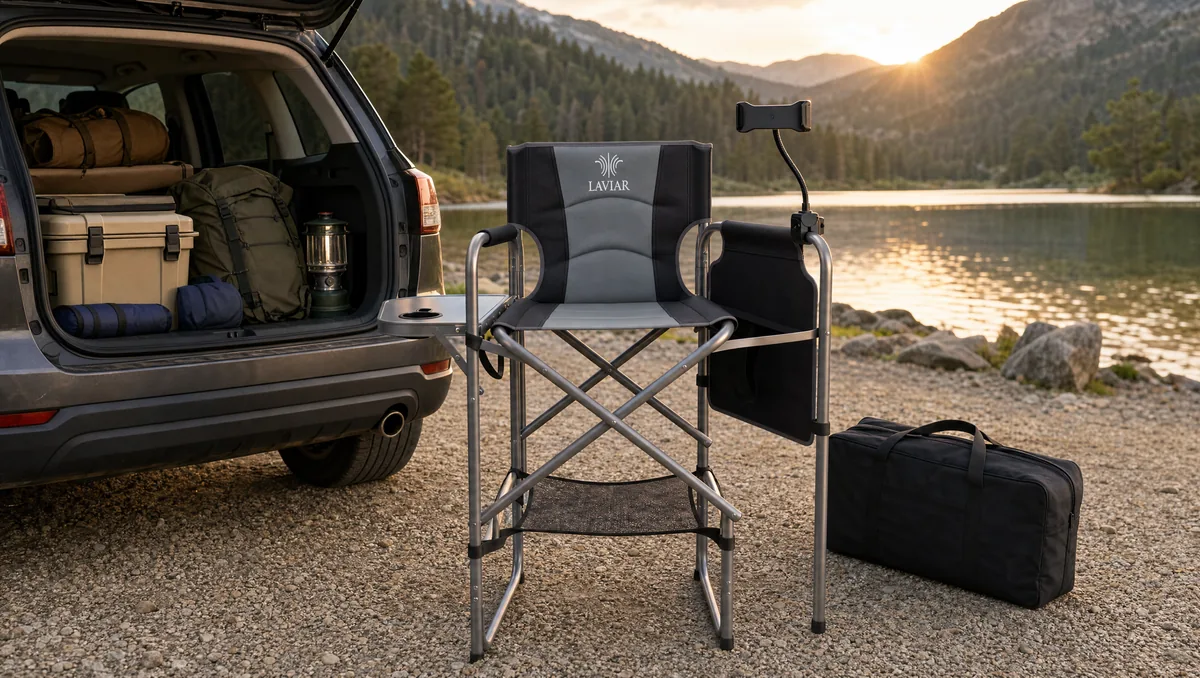
A fold-out side table with a cup holder. A gooseneck device holder for a phone, tablet, or mirror. A rear organizer plus under-seat mesh and a side pocket, so gear actually lives on the chair. A 300 lb tested steel-aluminum frame with double-layer 600D Oxford. And, worth checking before you buy, whether it comes in more than one colorway, LAVIAR ships Blue/Gray and Black/Gray at $99.99.
Of those, the table is the one that changes how you use the chair rather than how comfortable it is, and it is also the one most often done badly. A clip-on fabric tray is not the same product as a rigid panel on a bracket, and the side table buying guide goes through mounting, cup recess depth, and what the surface can hold.
Setup, takedown, and the pinch points
A director's chair opens by pulling the two side frames apart until the under-seat brace locks, which takes about five seconds once you have done it twice. Two habits save you grief. Keep your fingers on the outside of the frame while it closes, since the scissor action under the seat is exactly where fingers get caught. And open the chair fully before sitting rather than most of the way, because a brace that is not seated is the one way this design can drop someone.
Takedown is the same in reverse. Fold the table flat first, then close the frame, then bag it. A chair that goes into its bag every time gets carried by the handle rather than by the fabric, which is worth more to its lifespan than any single spec.
Measure before you buy, not after
Three numbers decide whether a chair fits your life, and only one of them is usually on the listing. Seat height is the one everybody reads. The other two are the folded footprint and the open footprint. Folded, a flat-folding tall chair is a rectangle roughly as wide as its seat and as tall as its back, which is what has to slide into your trunk, bay, or closet, and it is worth putting a tape measure on that space before ordering rather than after. Open, the chair occupies more floor area than a bag chair because the legs splay for stability, which matters inside a ten-by-ten booth or a small awning footprint where every square foot is spoken for.
The fourth number, if you use the table, is how far the table extends past the armrest. That is the dimension that decides whether two chairs sit side by side or have to be staggered, and it is why a pair of table-equipped chairs takes more width than you expect at a campsite pad.
Care and storage
Wipe the fabric with mild soap and water and let it dry open before bagging, because a chair stored damp in a sealed bag grows mildew in the fabric weave and there is no fixing that afterward. Store it out of direct sun when you can, since UV, not use, is what eventually fades and weakens outdoor fabric. Check the joints once a season and tighten anything that has worked loose. None of this is demanding, and it is the difference between three seasons and eight.
Who should not buy one
Backpackers, because 16 lb is not a hiking weight and no amount of features changes that. Anyone whose main use is a stadium row or a crowded beach canopy, where a tall chair blocks the person behind you. Anyone whose only storage is a small trunk corner already full, where a tube chair genuinely fits better. And anyone who wants to recline, since the seat is fixed by design.
Where each style ends up
The style keeps getting recommended in RV and overland communities for reasons covered in the RV and overlanding write-up, and the head-to-head against the bag chair most people already own is in the director's chair versus quad camp chair comparison. If you are choosing between them on one question, make it this: do you want to sit, or do you want to sit and do something.
Frequently asked questions
Are directors chairs good for camping?
Yes. Outdoor models use 600D fabric and coated frames. Their flat fold and rigid build make them better work-and-eat chairs than bag chairs, at a similar weight.
How much does a good folding directors chair cost?
Basic short ones start around $50; a tall, accessory-equipped chair with a tested frame runs $90–130. The LAVIAR set is $99.99 on Amazon.
How do you store a folding directors chair?
It folds flat rather than into a tube, so it slides behind a car seat, under gear in a trunk, or against a wall. Let the fabric dry fully before bagging it to avoid mildew.
Is a directors chair comfortable for long periods?
It holds a flat seat and upright back rather than wrapping around you, which suits eating, working and watching better than lounging. Tall versions need a footrest bar, since your feet do not reach the ground.