Mobile Makeup Artist Chair Checklist: What to Buy and What to Skip
Two different products share one name
Search for a makeup chair and you get two categories mixed together. One is salon furniture: reclining esthetician and lash chairs from suppliers like Aesthetic Pro, sold through Wayfair and salon distributors, built to lay a client flat, heavy, and meant to stay in one room. The other is the tall director style used on set and on location, the kind EVER ADVANCED and LAVIAR sell, which seats the client upright at working height and folds into a bag. They cost different money and solve different problems, and the listings do a poor job of telling you which one you are looking at.
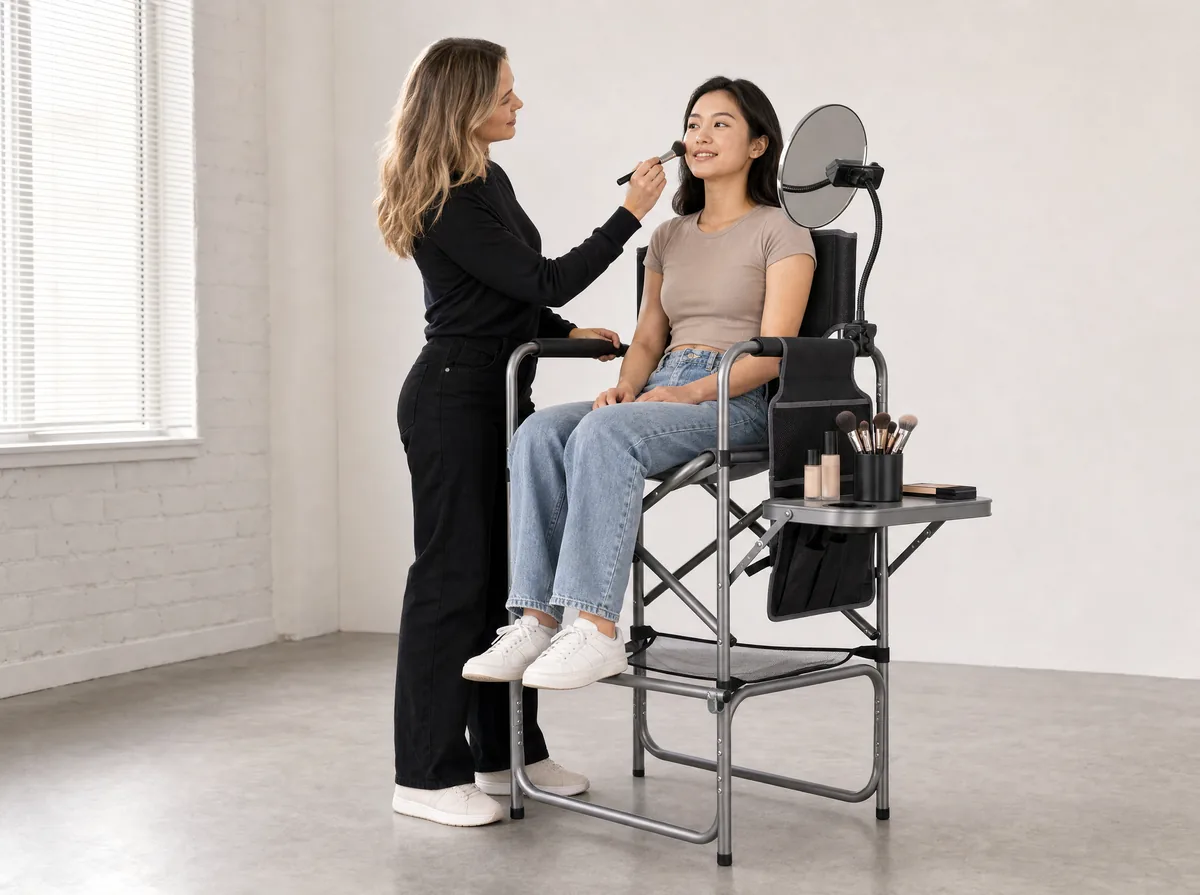
Pick by whether the client lies down
That is the whole decision. Lash extensions, facials, brow lamination and anything where the client is horizontal need a reclining chair or a bed, and a director's chair cannot do it at any price. Bridal makeup, event and party work, on-set beauty, photo shoots and craft or brand activations all happen with the client sitting up, and for those the director style is better in every way that matters on location.
Artists who do both usually end up with both, one chair that lives in the studio and one that lives in the car. That is a legitimate answer and cheaper than buying a portable chair that half works for lash work, which does not exist.
The checklist for on-location work
Seat height comes first. Somewhere in the 28 to 31 inch range puts a seated client's face at a standing artist's natural working level, which is the difference between working upright and bending over someone for an hour per face. LAVIAR's is 30.7 inches. Then a footrest bar, because a client in a gown with her feet dangling will shift and fidget, and a stable client is a faster face.
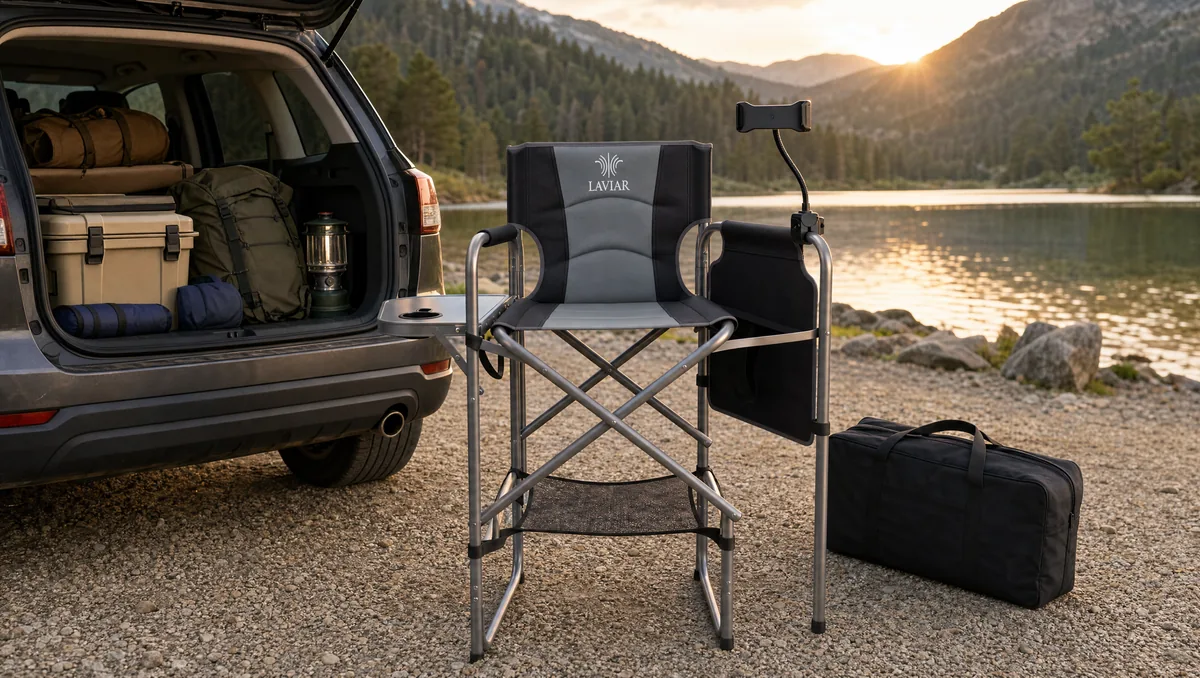
After that, look at what the chair carries for you. A gooseneck holder takes a ring mirror so the client can watch, or a phone if you are filming the process. A fold-out side table with a recessed cup holder gives a palette somewhere to sit that is not your lap. A side pocket and a rear organizer hold brushes and a kit bag off the floor of whatever hotel room or backyard you are working in. Then check the frame: tested to 300 lb rather than a number printed on a box, since a chair that wobbles under a client is a chair you cannot use professionally. Last, the fold. It should go flat into a carry bag around 16 lb, which travels like a light tripod bag and leaves your hands for the kit.
Two of those items reward a closer look before you buy. Capacity wording separates a tested frame from a decorative number, explained in the weight capacity article. And table mounting separates a rigid panel you can set a palette on from a fabric tray that tips it, covered in the side table buying notes.
What to skip
Skip anything with a fabric ring instead of a recessed cup holder, since it stretches and stays wet. Skip clip-on trays that have to come off before the chair folds, because they get left behind. Skip a chair whose capacity number climbs without the frame description changing. Skip padded or upholstered seats for location work, because product soaks in and they do not wipe clean. And skip any chair that does not come with a bag, since a chair carried by its frame gets scratched and a chair carried by its fabric wears at the seams.
The load-in reality
A location job is a bridal suite on the third floor, a backyard with no path, or a studio with a service elevator. You are carrying a kit case, a light and stand, and the chair, usually in one trip because two trips cost you fifteen minutes you did not budget. A flat-folding chair at about 16 lb goes over a shoulder in its bag and lies flat under the kit case in a trunk. A tube chair stands up in the trunk and falls onto the case. That sounds trivial until the case has open palettes in it.
Three questions to ask the venue first
The chair solves the seating problem only if the room lets you use it. Ask about floor space before the day: a chair with the artist working around it wants roughly a six-by-six-foot clear area, and a hotel room with two beds in it often does not have that until something moves. Ask where the outlets are, since your light and your client's chair need to end up in the same part of the room. And ask about the floor itself, because a rug transition strip or an uneven tile line under one leg is what makes a rigid frame rock.
None of that takes more than a text message the night before, and it is the difference between setting up in four minutes and rearranging a bridal suite while six people watch.
Cleaning, and making the chair last
Foundation, setting spray and hairspray end up on the seat and the back panel every single job. Double-layer 600D Oxford wipes down with a damp cloth and mild soap and dries fast, which is why woven Oxford beats padded upholstery for this work. Clean it at the end of the job rather than the end of the month, put a clean towel or a disposable cover down when a client is in white, and let the chair dry fully open before it goes back in the bag. Bagging a damp chair is how the fabric mildews.
What each category costs
The money is the fastest way to tell the two categories apart. Reclining esthetician and lash chairs from salon distributors start in the mid hundreds and run into the low thousands for a hydraulic model with a motorized back, and they are sold with freight rather than shipping because they are furniture. Tall director-style chairs sit between roughly $90 and $130 once they have a tested frame and a real feature set, and LAVIAR lists at $99.99. Below about $70 you are looking at a claimed rather than tested capacity, single-layer fabric, and a clip-on tray in place of a mounted table, which is the version that shows up secondhand after one season.
Set that against what you charge. A single bridal party usually covers a director-style chair several times over, which is a different calculation from a salon chair that has to be amortized across a year of studio bookings. That gap is why part-time and location artists land on the portable style even when they can afford the other one.
What you give up
A director's chair does not recline, does not adjust height, has no hydraulic pump, and does not swivel. If you have a fixed studio and your work is horizontal, buy the salon chair. The trade is portability, and it only pays off if you actually travel.
There is no headrest either, which matters for anything where the client needs to relax their neck for a long stretch. For makeup application, where the client is upright and engaged and you are moving around them, that is not the constraint people expect it to be. The ergonomics of why the height itself does the heavy lifting are in the article on why makeup artists use tall directors chairs.
Off-season use
The same chair that goes to a bridal suite in June goes to a market booth in November and a campsite in July. That is a real part of the value at $99.99, and it is one reason artists who work location gigs part time end up on the director style rather than a dedicated salon piece.
The booth side of that has its own logic worth reading if you sell at markets, in the piece on vendor seating at craft shows, and the general height case is in the tall chair guide. LAVIAR ships Blue/Gray and Black/Gray, and the black is the one that hides product between cleanings.
Frequently asked questions
Can I use a director's chair for lash extensions?
No. Lash work needs the client lying flat, which means a reclining lash or esthetician chair. A director's chair only suits upright work like makeup application.
What seat height should a makeup artist chair be?
About 28 to 31 inches, which brings a seated client's face to a standing artist's working level. The LAVIAR tall directors chair is 30.7 inches.
Will a tall makeup chair fit in a car with my kit?
Director-style chairs fold flat rather than into a tube. The LAVIAR packs into an included carry bag at roughly 16 lb and lies flat in a trunk under a kit case.
Is a padded seat better for client comfort?
For location work, no. Padded upholstery absorbs foundation and setting spray and cannot be wiped clean. Woven double-layer 600D Oxford on a rigid frame stays supportive and cleans up after every job.