Why Makeup Artists Use Tall Directors Chairs (and What to Look For)
The ergonomics: your back is the business
On a standard chair a seated client's face sits at your chest height, so you bend. Over a wedding-day schedule that's hours of flexed-spine work. A 30.7-inch seat raises the client so you work upright, the same reason barbers pump their chairs up.
Run the numbers on your own body and it gets concrete. A seated adult's eye level sits roughly 28 to 32 inches above the seat surface. On an 18-inch dining chair that puts a client's eyes somewhere near 46 to 50 inches off the ground, which is chest height for a 5'6" artist standing normally. On a 30.7-inch seat the same client's eyes land near 59 to 63 inches, which is eye to chin height for that same artist. The first case means you bend or you sit on a stool and crane upward. The second means you stand up straight and move your hands.
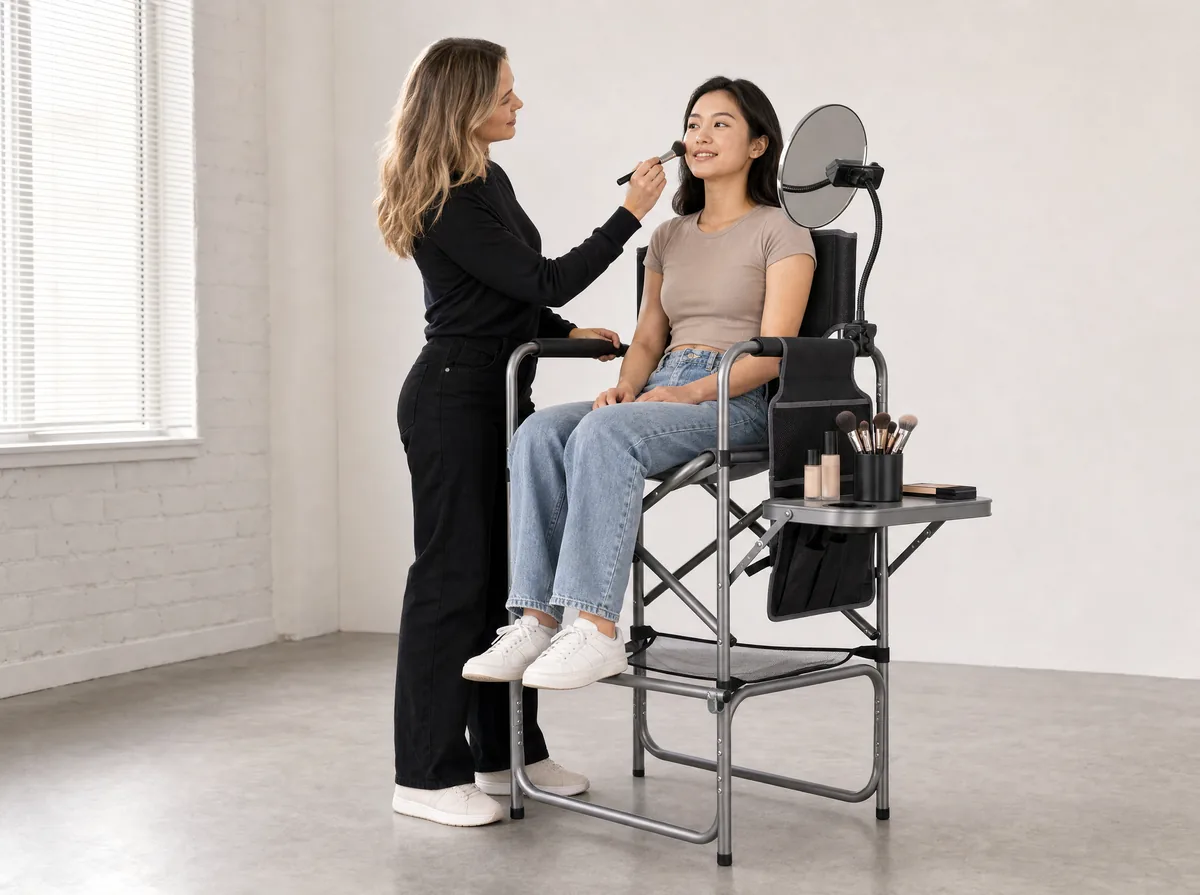
The hour-per-face math
A bridal party of six is six faces, and a full face runs 45 to 60 minutes when you are being careful. That is five to six hours of the same posture in a single morning, often starting at 5am, often in a hotel room with no good chair in it. Whatever posture you pick, you hold it for the whole day. Artists who work standing at a raised chair describe the difference at the end of a season rather than at the end of a job, which is exactly the kind of cost that is easy to ignore while you are building a business.
What a mobile artist actually needs in the chair
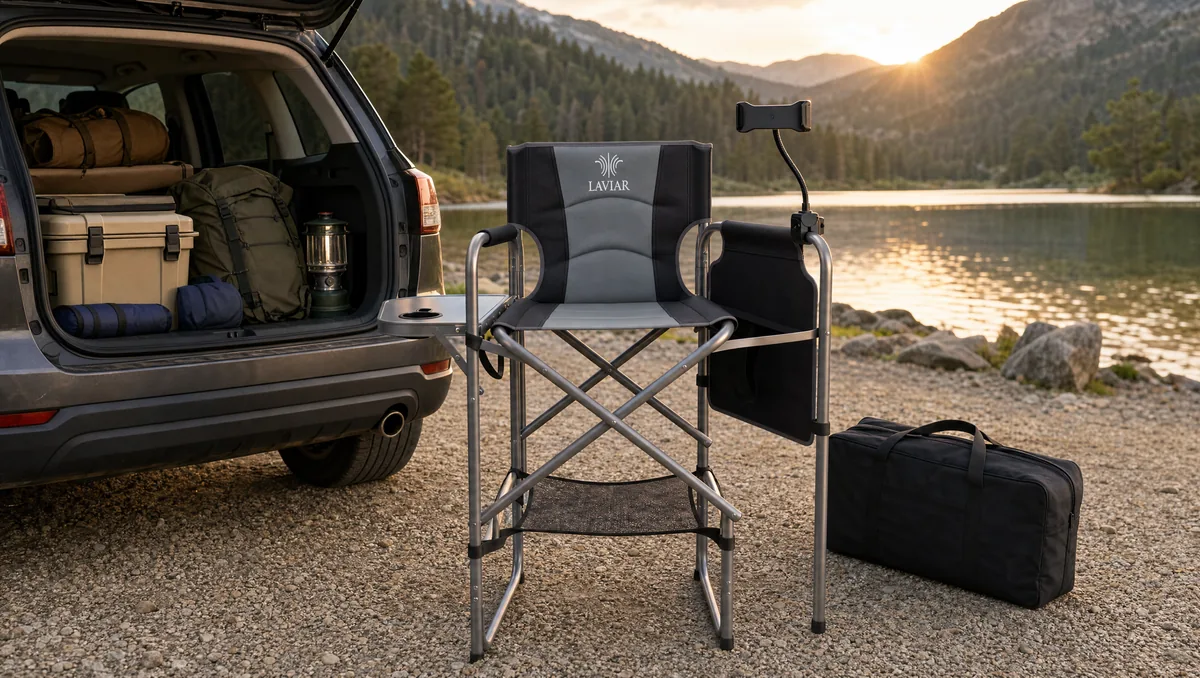
A gooseneck holder grips a ring mirror or phone at any angle, so the client can watch, or you can film content hands-free. Brush storage at hand height matters too: the side pocket takes brush slots, and the fold-out table takes a palette. A footrest bar keeps clients in dresses stable and comfortable at height. And it should fold flat into a carry bag around 16 lb, travel to a venue like a light tripod bag, with a 300 lb-tested frame that seats any client safely.
The gooseneck is the piece artists underestimate before they own one. Handing a client a mirror ends the application, because now they are holding something and moving their head. A mirror clamped in front of them at the angle you choose lets them watch without becoming part of the process. The same arm holds a phone for process video, which is most of the content this business runs on, and it holds it steadier than a friend does.
The client's side of the chair
A chair the client dislikes costs you time even if it is perfect for you. Three things decide that. The footrest bar comes first, because a client in a gown with her feet dangling will shift and fidget, and every shift is a line you have to redraw. Getting in comes second: at 30 inches the client steps up rather than sits down, so say so out loud and offer a hand, particularly with a long dress. Seat width and firmness come third. Double-layer 600D Oxford stretched on a rigid frame holds its shape through a long sitting instead of sagging into a hammock, which matters when someone is sitting still for an hour.
Where the chair goes in the room
Height solves your back. Placement solves your light, and the two are separate problems that the chair only half answers. On location you are usually working with a hotel window, a ring light on a stand, or both. Put the client's chair facing the window at a slight angle rather than square to it, so the light wraps rather than flattens, and keep your own body out of the line between the window and the client's face, which is the mistake that costs you twenty minutes of second-guessing a base.
The height helps here in a way that is easy to miss. A client at 30 inches sits inside the useful part of a standard light stand's range, so a ring light on a stand hits the face straight on instead of pointing down at a scalp. On an 18-inch chair the same stand has to come down low enough that it starts appearing in every mirror shot and getting kicked. A chair that fixes the client's height also fixes where your light lives, which is one fewer thing to solve in a room you have never worked in before.
Two practical habits: leave about three feet of clear floor on the side you work from, and keep the chair off carpet edges and rug transitions, because a leg on a transition strip is the one thing that makes a rigid frame rock.
Fabric, and the part nobody warns you about
Foundation, setting spray, and hair product all end up on the chair. Woven Oxford fabric wipes down and dries fast, and a double layer takes repeated cleaning without the surface fuzzing. Two habits worth having from day one: wipe the seat and the back panel at the end of every job rather than at the end of every month, and put a disposable cover or a clean towel over the seat when a client is in white. Neither is a chair feature, both are why one artist's chair looks new after two seasons and another's does not.
Travel and load-in
Location work is a load-in problem before it is a beauty problem. You are carrying a kit case, a light, a stand, and now a chair, usually up a flight of stairs or across a parking lot. A flat-folding chair at about 16 lb goes over a shoulder in its bag while your hands take the kit, and it lies flat in a trunk under the case instead of standing in a corner and falling on it. A tube-folding chair does the opposite, and a salon chair does not travel at all.
What you give up
A director's chair does not recline, does not adjust height, has no hydraulic pump, no swivel, and no headrest. If you work on lashes, brows, or facials, the client has to be horizontal and none of this applies. The full comparison between director-style seating and true reclining salon furniture, including which buyer needs which, is laid out in the mobile makeup artist chair checklist. Buying the wrong category is the single most expensive mistake in this corner of the market, and the listings are genuinely unclear about which one they are selling.
What to check on the spec sheet
Seat height in the 28 to 31 inch band, stated as a real number. A frame described as steel and aluminum with cross bracing rather than "metal." A capacity that says tested rather than claimed, which matters more here than in casual use because a chair that shifts under a client is a chair you cannot use professionally, and the reasoning behind that wording is in the piece on reading a chair's weight capacity honestly. A rigid fold-out table rather than a fabric tray, since a palette on a sagging tray slides, covered in more detail in the side table buying notes. And a fold that packs into an included bag, so the chair travels as one item.
One chair, two businesses
The same chair works weekend markets, brand activations, and family campsites. That is why a director-style chair beats a dedicated salon chair for anyone mobile.
Artists who also sell at markets get double use out of it, and the seating argument on that side of the business is its own thing, covered in why vendors work from a tall chair at craft shows. LAVIAR's tall directors chair lists at $99.99 in Blue/Gray and Black/Gray, with the table, cup holder, gooseneck holder, footrest bar, and storage pouch included, which is the sort of price where the chair pays for itself against one avoided back-injury week.
Frequently asked questions
What height should a makeup chair be?
Around 28–31 inches of seat height puts a seated client's face at a standing artist's working level. The LAVIAR tall directors chair is 30.7 inches.
Does a tall makeup chair fold for travel?
Director-style makeup chairs fold flat. The LAVIAR packs into an included carry bag at roughly 16 lb, lighter than most rolling kit bags.
Can a client in a long dress use a 30-inch chair?
Yes, with two habits: offer a hand on the way in, since the client steps up rather than sits down, and make sure the chair has a footrest bar so her feet are supported once she is seated.
How do you clean makeup off the chair fabric?
Double-layer 600D Oxford wipes down with a damp cloth and mild soap and dries quickly. Clean it at the end of each job rather than letting product set into the weave.